Fishing the Reef
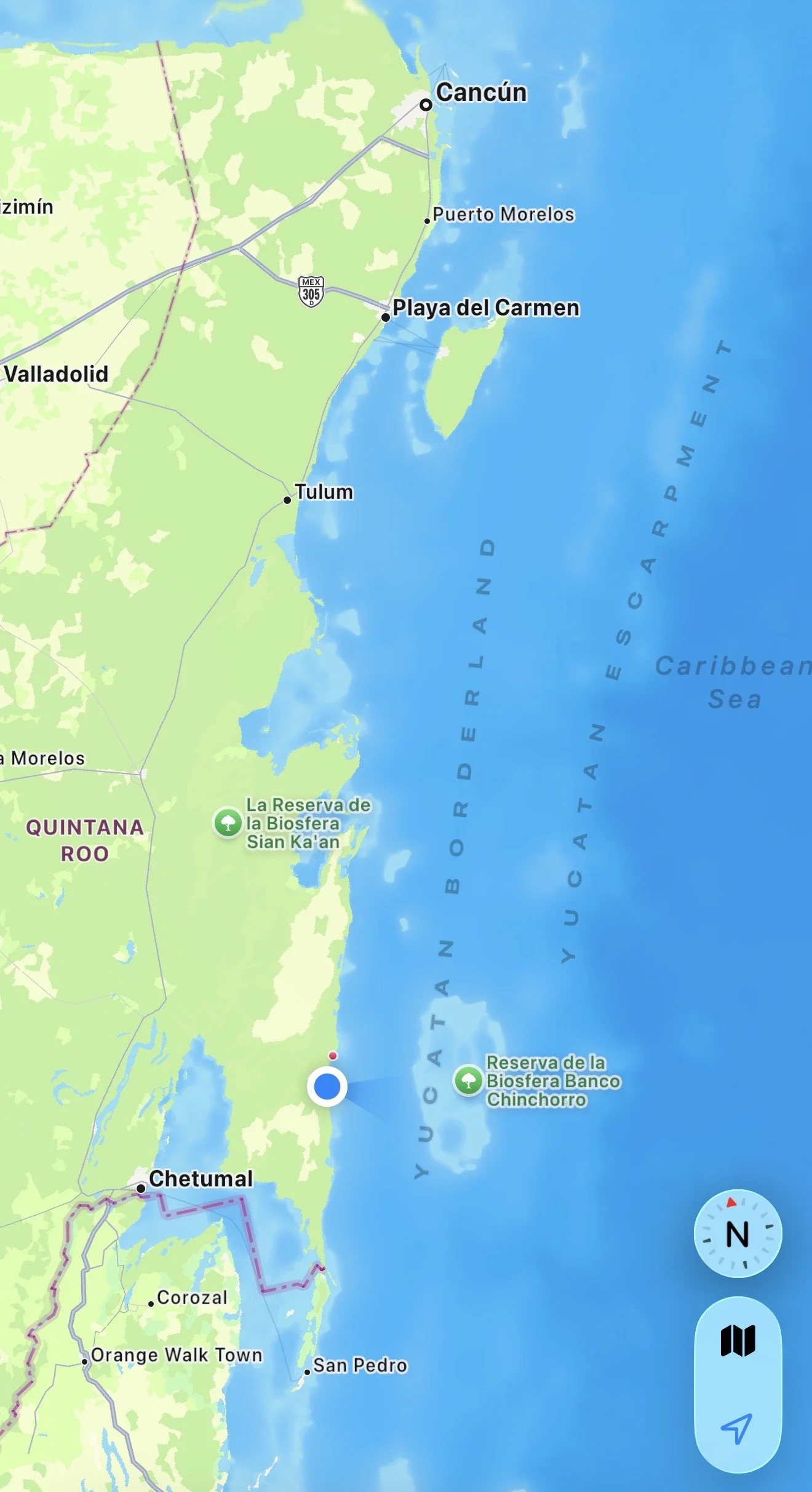
At 3 p.m., I am sitting on Oscar’s moto as he proudly winds his way down the dirt path, much faster than we could ever manage in the car. A large white cement wall suddenly greets us, and we pull to a stop at the property.
A dog comes charging over to perform his official dog duty, barking as he approaches. But I can tell immediately that he is more curious than upset. Canelo. Within minutes, he lets me pet him and we are officially great friends. His long lashes flutter in the wind as he half-closes his eyes, clearly enjoying the attention as much as I am enjoying giving it.
We wait for the fisherman who will take me out to sea to fish and snorkel the reef, along with two of his wife’s boys. The youngest is clearly a little fish himself. His wetsuit is already on. He loves to bucear and, apparently, is always ready to return to the sea.
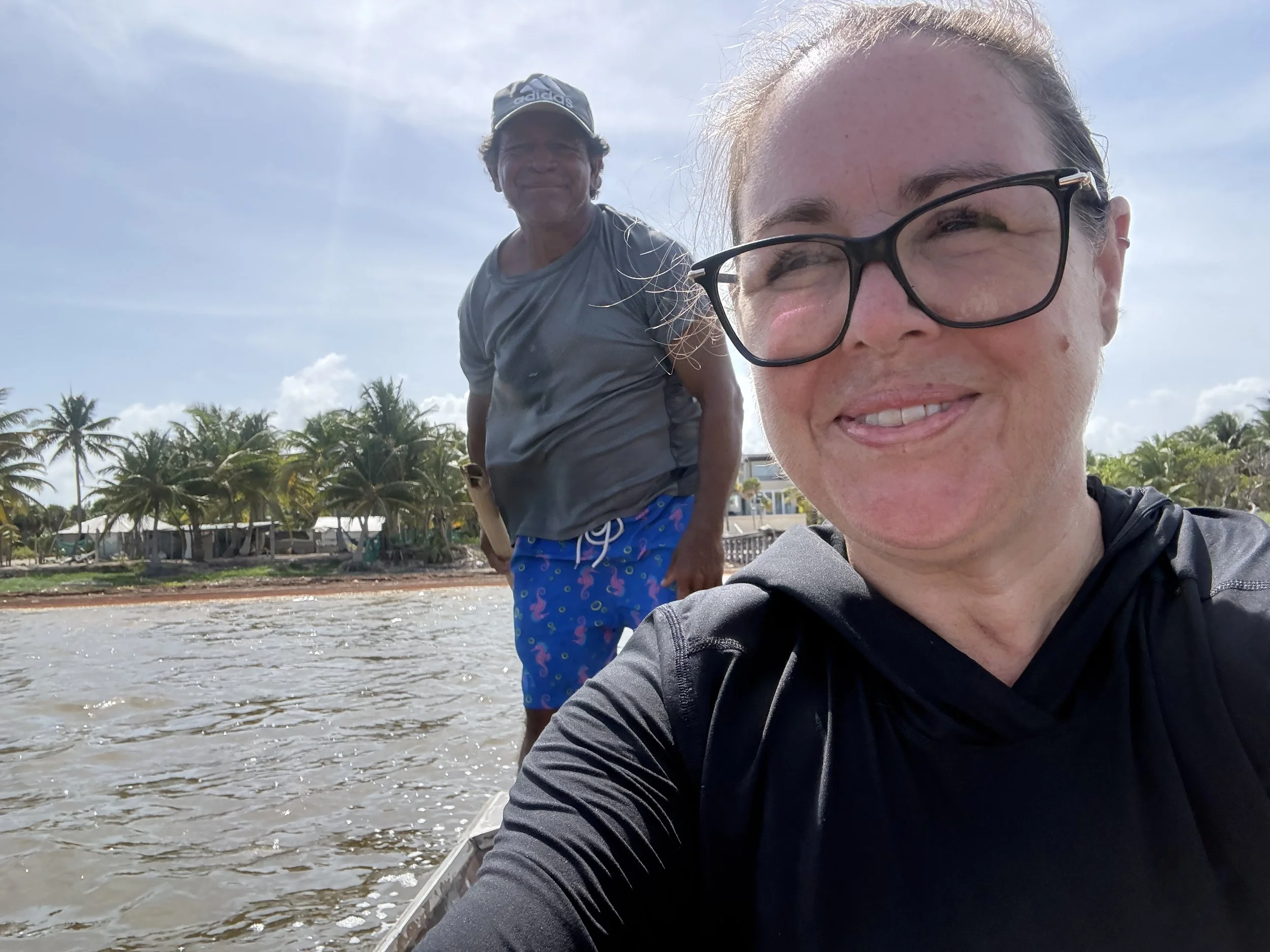
The wharf is high and long, stretching out until it ends almost exactly where the sargassum does. I climb down into the small fishing boat, where someone has thoughtfully placed a chair for my comfort.
There is no motor.
The fisherman tells me he is going to show me how they traditionally fish and take me out toward the reef, where it is possible to catch 12 to 15 kilos of very yummy beasts.
He picks up a long, broad piece of bamboo, perhaps seven feet tall, and begins using it to maneuver and push the boat toward our fishing spot.
Most fishermen here don’t fish with a cane. My host expertly prepares large pieces of sardine, cutting them into generous chunks. Then a bucket appears, containing wheels of fishing line, each one for a different grade of line. Where the line is free, he grabs the hooks, inserts them into the sardine, circles the bait over his shoulder and, with astonishing precision, casts the whole thing out over the water.
Then he places the line in my hand.
“Hold it barely,” he explains.
I am to feel the line rather than really hold it, letting it wrap once around my index finger. Keep it up. They will bite, but don’t pull.
Once they decide they actually want it, I will feel the tug.
That’s when we pull.
In my mind, fifteen kilos of fish attached to a thin fishing line wrapped around my finger feels like a questionable arrangement at best. But I am surrounded by seasoned fishermen, so I decide to trust the process.
And then there are the sharks.
Apparently, the sharks on this reef aren’t particularly aggressive. The fisherman seems far more concerned about my earrings and jewelry.
Barracuda.
Oh, yeah.
Slap to the forehead.
I always forget about those guys.
Every snorkeling adventure seems to follow the same script. I forget that I am wearing earrings or my wedding rings, and then, inevitably, I see a barracuda somewhere in the distance and suddenly remember.
I frantically take off the bling.
Just in time.
Barracuda are known for charging shiny objects, and apparently they are not particularly interested in whether the jewelry comes attached to a finger, an ear or the rest of the body.
Today, I am going fishing with nothing shiny except the fish themselves
The youngest of the two boys throws the anchor overboard and, with the effortless agility of someone who has spent half his life in the water, dives into the warm Caribbean sea to scout the area for fish.
Not much.
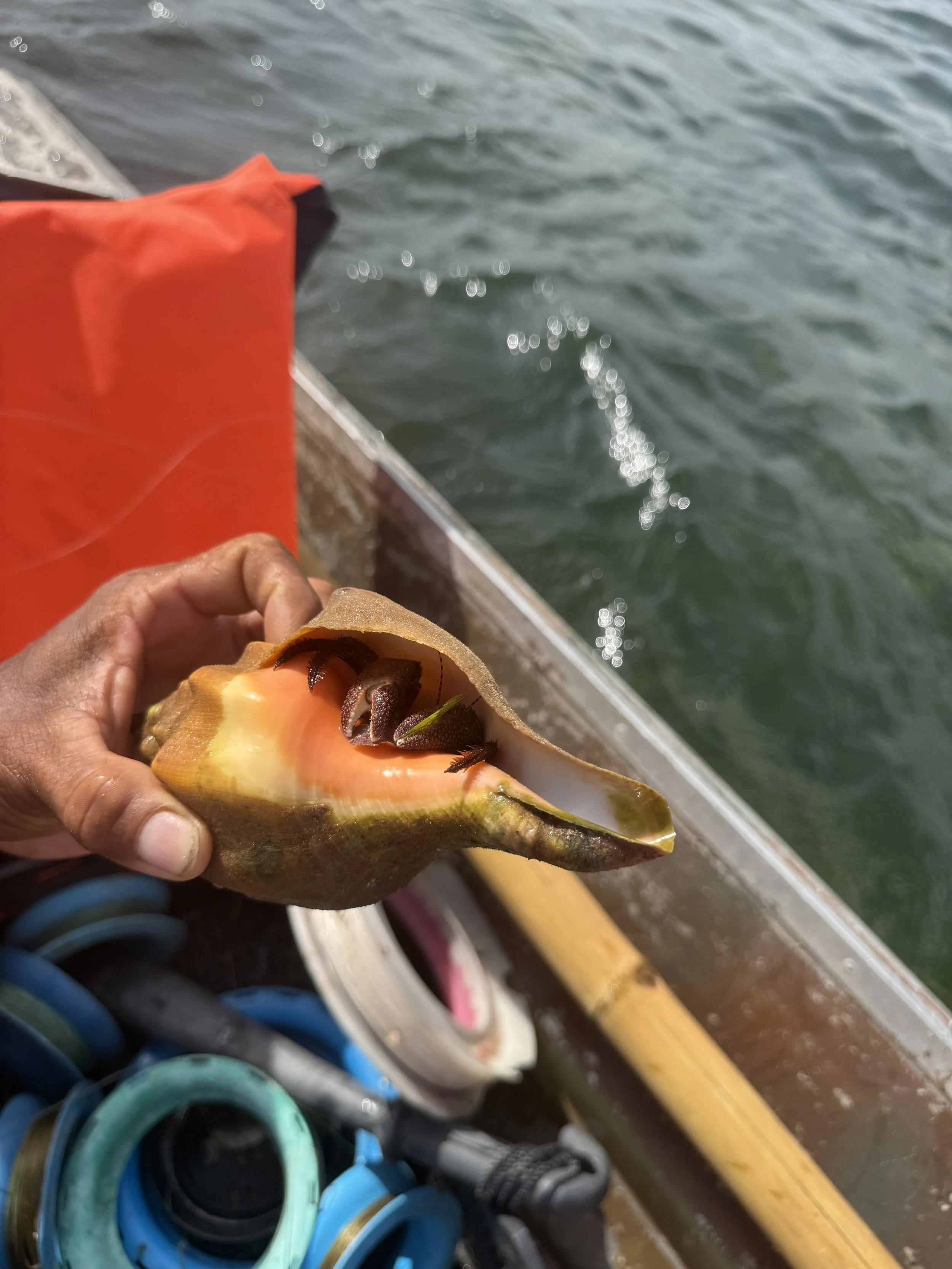
He comes back up a moment later carrying a conch, a caracol. Delicious in ceviche. There is still life inside the shell, though, so instead of becoming lunch, it is passed to our captain.
A hermit crab has apparently decided that someone else’s abandoned home makes a perfectly respectable piece of real estate.
He is returned to the reef, shell and all, and disappears back into the underwater world from which he came.
Eventually, I follow the young avid swimmer into the water.
The reef opens beneath me, and I immediately lose any sense of time.
Sponges the size of boulders from the Canadian Shield rise from the reef, absurdly out of place in this warm Caribbean world. Around them, tropical fish flash electric blues, greens and yellows, some dotted, some lined, some striped. There are so many patterns and colours that eventually I stop trying to name them and simply let myself drift through the spectacle.
Until I see a manta ray.
She is enormous. As wide as I can stretch my arms, and with a tail that seems to go on almost as long as her body. I swim alongside her for a while, following her slow, effortless movement. Her bulging eyes seem almost comically visible, and I can’t help wondering if she is wondering what the hell I am doing following her.
Eventually, I let her go and return to my own investigation.
Purple and orange sea fans spread from the reef like delicate lace. A sea urchin catches my attention, its round body covered in protective black spikes, with flashes of deep red and purple beneath.
Then the manta ray comes back.
Or is it another one?
No.
Two.
Two enormous manta rays, almost identical in size, glide through the water one behind the other. I cannot resist following them.
The second one, apparently less enthusiastic about my company, suddenly becomes nervous. Her entire body begins to undulate, sending up a cloud of sand from the bottom until she almost completely disappears into it.
Message received.
I let her continue peacefully and watch as the two of them retreat toward quieter waters.
When we finally return to the boat, two or three hours have passed.
The sun is beginning its slow descent, and the patches of sargassum have grown large enough to interfere with the fishing. Despite everyone’s efforts, the catch is modest: one conch and a few small lobsters.
Then, suddenly, the birds appear.
They gather and circle with a very particular kind of interest, and soon we see something large moving toward us beneath the surface.
Lines go in.
It appears to be a shark.
The captain quickly selects a heavier grade of line. But the sargassum is everywhere, tangling and interfering with the presentation. The shark nibbles.
But it never commits.
Then another one appears.
We watch them instead.
Sometimes the sea gives you dinner. Sometimes it gives you a show.
The captain estimates them at ten to fifteen kilos each.
Today, they are not for us.
And somehow, I am perfectly happy with that.
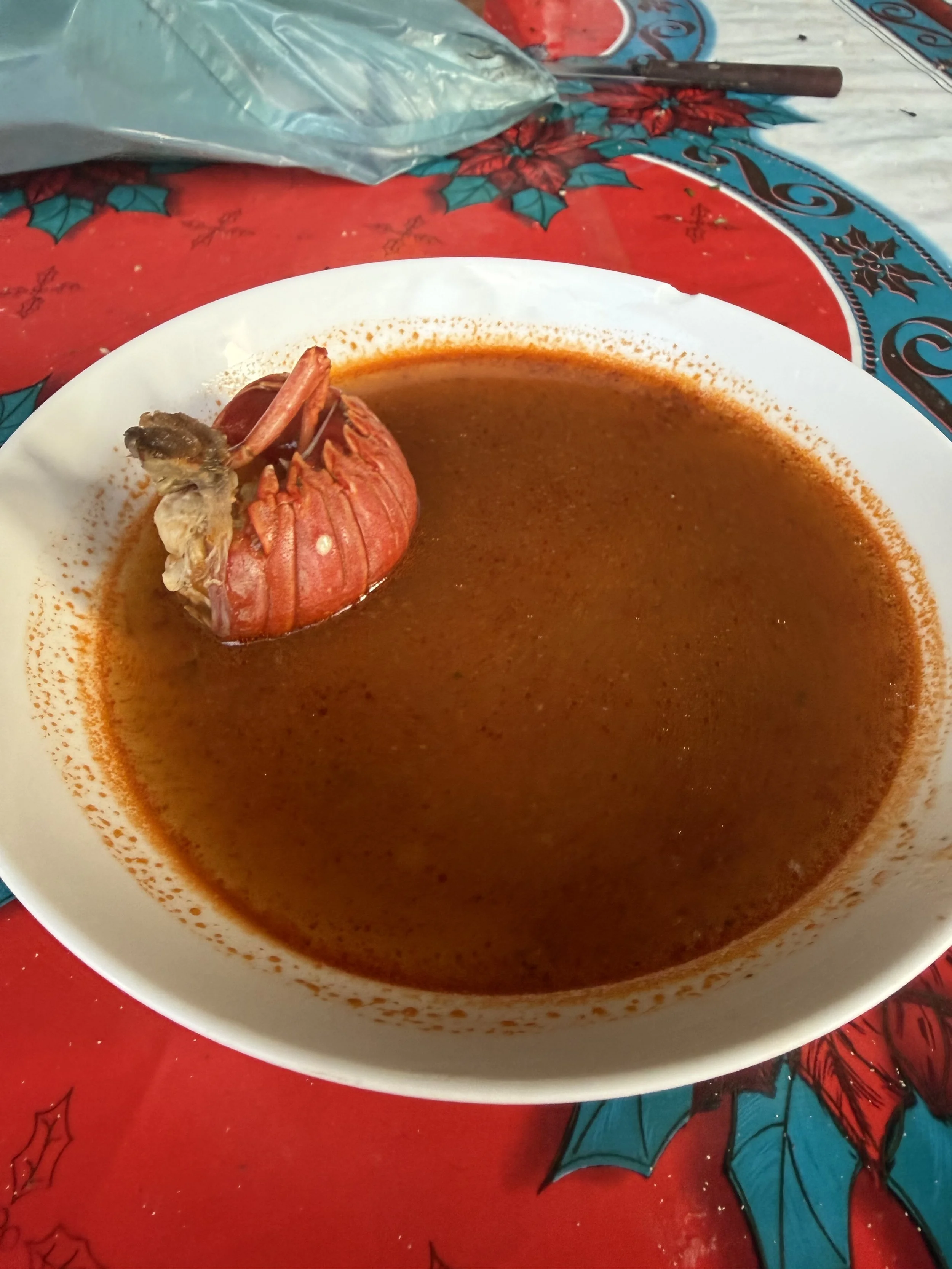
We return to shore as the light begins to soften, and I am greeted by the smell of something wonderful. His wife has prepared a rich fish broth, deeply flavoured and perfectly spiced. Into the broth she adds baby lobster and pieces of fish fillet, turning what could have been a simple soup into something wonderfully substantial.
There are fresh habaneros on the table and a pitcher of agua fresca de jamaica.
Jamaica, made from hibiscus flowers, is one of those everyday Mexican drinks that feels much bigger than simply something to drink. Aguas frescas belong to the rhythm of Mexican cooking and eating: refreshing, inexpensive, homemade drinks made from fruit, flowers, grains or seeds, served alongside a meal to cut through heat, spice and richness. Jamaica is tart and floral, almost cranberry-like, and when lightly sweetened it is the perfect counterpoint to a bowl of hot, spicy fish broth.
I crack open a habanero and press a little of it into my broth.
Soooooo good.
After dinner, our captain shows us what happens to the conch.
He takes a machete and breaks open the shell, then uses a small paring knife to pull out the enormous inhabitant.
It is… surprisingly large.
And very, very hard-looking.
I have a difficult time imagining this creature becoming the delicate ceviche I had envisioned.
But apparently, I am simply unfamiliar with the process.
He explains that all of the black, tough outer skin has to be removed. Then the meat is gently boiled until tender, anywhere from half an hour to an hour and a half, depending on its size.
He seems genuinely disappointed that we haven’t returned with fish for dinner. Perhaps he feels responsible for the success of our fishing expedition.
So he gives me a frozen fish fillet caught yesterday. Saw fish. He cleaned conch to take home and make ceviche.
Our fridge is already full.
So instead, I decide to offer them to Oscar and his family.
Oscar turns the gift into ceviche, and judging by the enormous smile looming over the next bite, it disappears very quickly.
There is something about that ending that feels exactly right.
I went out to the reef hoping to catch dinner.
Instead, the sea gave me manta rays, sharks, a conch, a few lobsters, a lesson in traditional fishing, and a meal I will remember.
And in the end, the fish found its way to a family who could enjoy it.
Not a bad catch at all.