The Mexico You Don’t See From the Road
The Mexico You Don’t See From the Road
I’ve been drafting this post for a while because Mexico is such an interesting land, and the longer I stay, the more I realize that some of its stories deserve a little care in the telling.
Throughout this trip, I’ve met so many deeply profound and passionate people. Staying in one place for a week has allowed me to move beyond the usual exchange between traveller and local and, in small ways, enter the lives of these souls and their families.
It has been humbling.
I am incredibly grateful for these unexpected opportunities placed right in front of me, each one carrying a story, a history, or someone preparing for their next adventure.
The truth is, I connect easily with people. Somehow, people open up to me quickly, sharing secrets, personal experiences and pieces of their lives that they might not ordinarily share with a stranger. And I love it.
I leave a little of myself with them, while they offer me a beautiful, sometimes brutal and occasionally frightening glimpse into their daily lives, without much censure.
And that glimpse is not always comfortable.
I was told, quite casually and almost in a hushed voice, about something referred to as “propina del mar”, stories of suspicious packages washing up along the coast and being quietly collected and passed along without anyone asking too many questions. I have seen hilarious movies built around exactly this sort of thing, but I had never actually spoken with anyone about it.
Hearing it discussed so matter-of-factly was different.
I am deliberately leaving the details, names and places out of this. These are things people shared with me in confidence, and I have no interest in turning someone’s reality into a travel anecdote at their expense.
Then there is the complicated world of fishing.
There are protected species here, including turtles and their eggs, sea cucumbers and, in this area, caracol. I learned today that caracol is quite delicious in a ceviche, which makes the regulations around it all the more interesting. I was told that there are permits in some circumstances, yet the boundaries between what is permitted, prohibited, tolerated and enforced can appear surprisingly complicated from the outside. Caracol, for example, appears openly on restaurant menus along the boardwalk, while I was also told stories of people risking serious penalties for illegally fishing or transporting it.
What struck me most was the human side of it.
Some families depend on the sea for their food and income. I heard about the risks people take, including the possibility of severe fines and the loss of property. There are vigilance posts along the highways, and enforcement efforts aimed at identifying illegal fishing and transportation.
Yet in some of the communities I have visited, the sea is simply the pantry.
The people I spoke with described fishing only what they need to eat or sell, rather than taking more simply because it is there. From their perspective, it is not about exploiting the sea. It is about living from it.
And there it is again: the uncomfortable duality.
There is the legal perspective, the conservation perspective, and the perspective of someone whose family has depended on the sea for generations. All three can exist at the same time.
I don’t pretend to have enough knowledge to judge where the line should be drawn. I am only beginning to understand the complexity of it.
And then there are the conversations that take you somewhere entirely different.
I found myself in conversations about DMT and “sapo”, a term commonly used for experiences involving 5-MeO-DMT, a psychedelic compound related to but distinctly different from DMT. DMT is the compound most commonly associated with ayahuasca and certain plant preparations, while 5-MeO-DMT is known for an experience that can be profoundly immersive and overwhelming, often with far less emphasis on the vivid visual effects associated with DMT.
I found the conversations far more interesting than the substances themselves.
They were remarkably honest.
Sometimes brutally so.
And, as seems to happen again and again on this trip, there was always a story behind the person.
A life-altering moment.
A childhood prank that somehow went terribly dark.
A decision that changed the course of someone’s life.
A mistake.
An awakening.
A loss.
A strange turn of events that, years later, had somehow led them to where they were sitting, talking to a Canadian traveller in Mexico.
The storytelling was sometimes so animated that I wanted to burst out laughing, only to find myself moments later feeling a deep and unexpected sympathy for the person sitting across from me.
That is perhaps what I keep discovering here.
People are rarely the neat little categories we create for them from a distance.
The person sitting across from you may carry experiences you would never guess from looking at them. Someone can make you laugh until your stomach hurts and, five minutes later, tell you something that leaves you quietly reflecting on the fragility of a human life.
Human beings are gloriously inconvenient that way.
They refuse to fit neatly into the boxes we bring with us.
And perhaps that is why these conversations stay with me.
Not because I agree with everything I hear.
Not because I understand it all.
But because, for a few moments, someone trusts me enough to let me see the complicated person underneath the story.
And I think that is one of the greatest privileges of travelling.
Something else has happened to me during this trip that I didn’t quite expect.
I have become strangely disconnected from my ordinary life.
Not in a bad way. More like I have temporarily stepped outside of it.
For once, I am barely thinking about my Chihuahuas. I know. Those who know me will understand the significance of that statement.
My usual routines, responsibilities, schedules and familiar concerns have become wonderfully distant. Instead, my attention has narrowed to what is directly in front of me.
A smell drifting through the air.
Someone’s story.
A ridiculous joke followed by a deep, hearty laugh.
A conversation with someone I’ve known for twenty minutes that somehow feels much older.
I have connected again and again with communities that are so different from one town to the next, yet within each one there is this remarkable closeness. People know each other. They know each other’s families, histories, businesses, troubles and triumphs. There is a sense of belonging that is difficult to explain from the outside.
And it feeds my soul.
I find myself avidly taking it all in.
The smells. The food. The accents. The stories. The humour. The laughter. The way people talk about their lives.
Most of all, I am meeting people who feel intensely alive.
Not necessarily because their lives are easy. Quite the opposite.
There is hardship here. There are contradictions. There are things I don’t understand and probably never will. But there is also an extraordinary vitality in the people I have encountered, and it is contagious.
I came to Mexico thinking I was going to explore places.
Instead, once again, it is the people who have become the landscape.
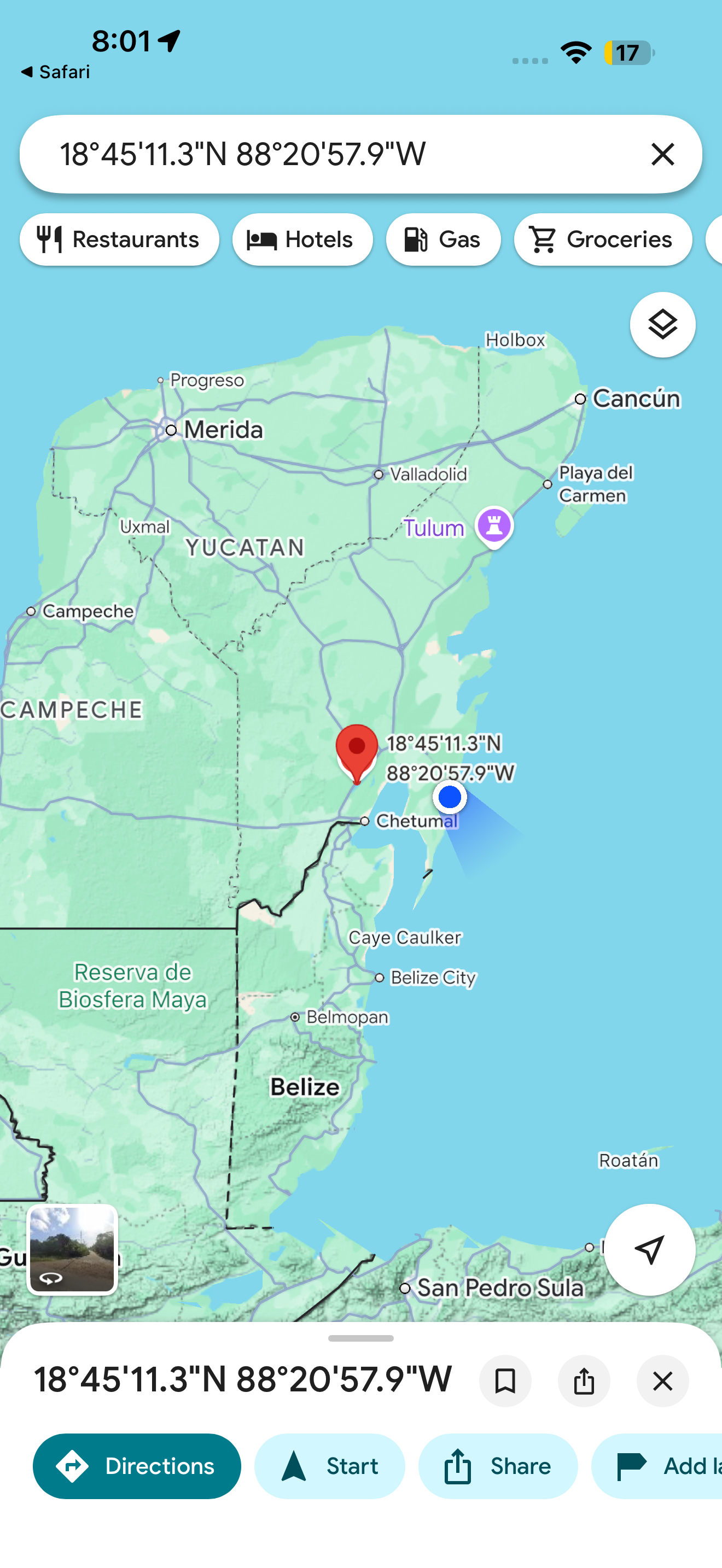
And tomorrow, we leave Mahahual.
Bacalar is next.
About an hour and a half inland, I have rented a house directly on the lagoon, surrounded by the strange beauty of this freshwater world.
Laguna de Bacalar is known as the Laguna de los Siete Colores, the Lagoon of Seven Colours, and the name is not an exaggeration. Depending on depth, light and the pale limestone beneath the water, the lagoon shifts through an extraordinary range of blues, from almost transparent turquoise to deep cobalt. Cenotes punctuate the lagoon, including the famous Cenote Azul, while ancient living stromatolites quietly build their structures beneath the surface.
There is even a local legend that the lagoon was chosen as God’s palette, where the colours were mixed before being used to paint the world.
I think I like that story.
After all, this trip has already taught me that sometimes the most beautiful things aren’t the ones you go looking for.
Sometimes they are simply waiting in the next town.
Thank you, Mahahual.
Tomorrow, Bacalar.